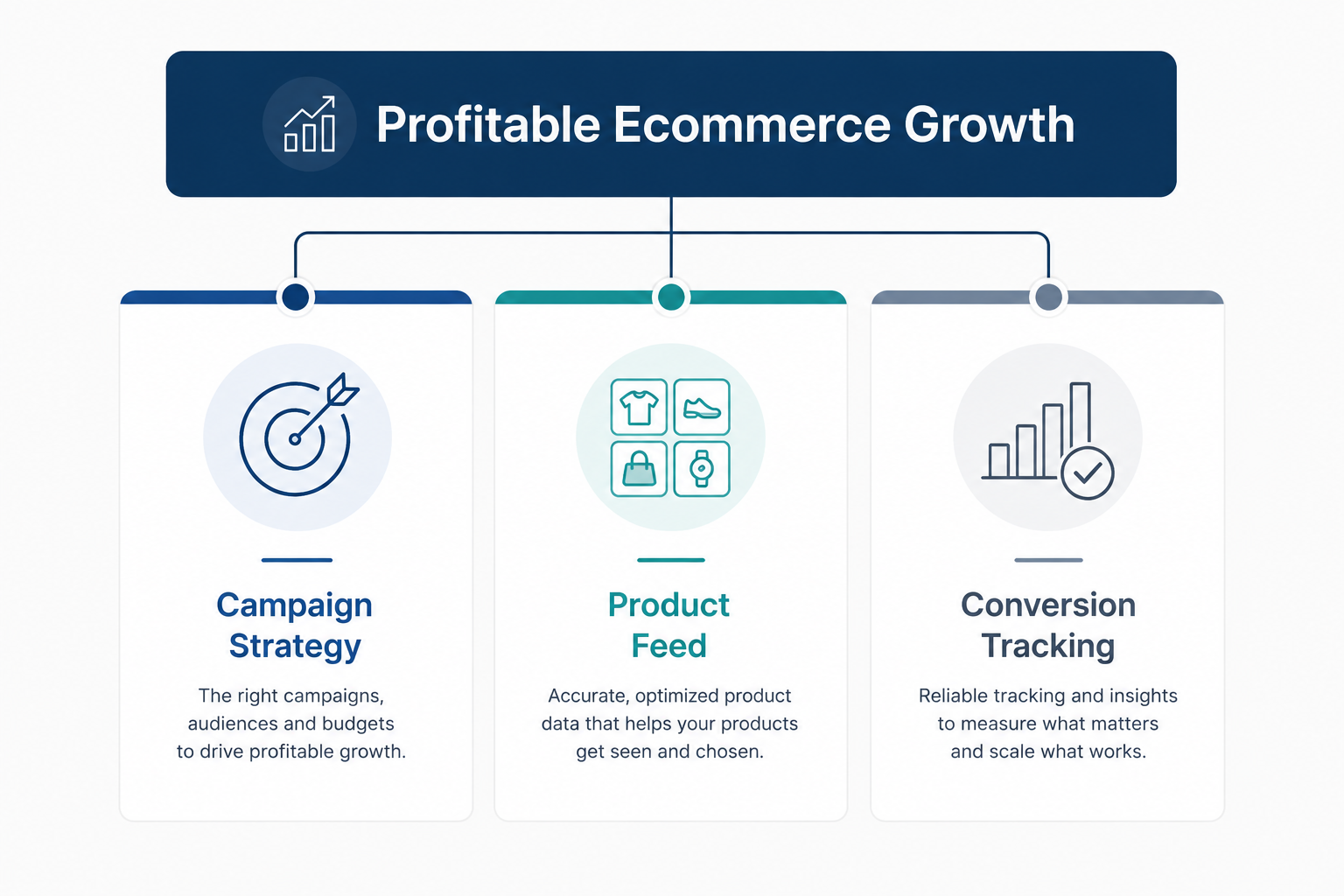
Google Ads management for ecommerce needs three separate skill sets: campaign strategy, product feed engineering, and conversion tracking. Almost no single in-house hire has all three. For most stores, an agency delivers all three from day one, costs less than one full salary, and gets to profitability faster. Keep it in-house only if you already have a specialist on staff and the volume to keep them busy.
The Question Behind the Question
Most store owners asking about in-house versus agency are really asking something simpler: who is going to do this well, and what will it cost me if they don't?
Both models can work. But they fail in different ways, and the failure modes are not equally expensive. A slow in-house hire burns budget quietly for six months. A bad agency burns it faster but shows up on a report you can act on.
This guide breaks down what Google Ads management for ecommerce actually involves, what each option costs, and where the real trade-offs sit.
What Google Ads Management for Ecommerce Actually Involves
Running ads for an online store is not one job. It is three, and they rarely live in the same person.
Campaign strategy. Deciding your mix of Shopping, Performance Max, Search, and remarketing. Setting bid targets that reflect margin instead of revenue. Planning budget across seasons and product lines.
Product feed engineering. Most store revenue moves through Shopping and Performance Max, and both run on your Merchant Center feed. Title optimization, custom labels, margin-based product tiers, and exclusions decide what Google shows and to whom. A neglected feed caps performance no matter how good the campaign settings are.
Conversion tracking. GA4, Google Tag Manager, and Merchant Center have to agree with each other before a single decision is trustworthy. Duplicate purchase events and missing enhanced conversions are the most common problems in ecommerce accounts, and they quietly corrupt every optimization that follows.
Ecommerce Google Ads management means doing all three continuously, not once at setup. That is the part most in-house plans underestimate.
The Case for Keeping It In-House
In-house has real advantages, and they are worth naming honestly.
You get product knowledge that no external team can match. Your marketer knows which SKUs carry margin, what stock is about to run out, and which bundle the founder wants pushed this month. That context turns into faster decisions.
You also get availability. No ticket queues, no waiting for a monthly call. And over years, the institutional knowledge stays in the building.
The catch is capability. Ecommerce PPC has become significantly harder to run well. According to The State of PPC 2026 report, 53% of PPC marketers say campaigns are harder to manage now than they were two years ago, driven by automation, reduced audience visibility, and less granular control. A generalist marketer splitting time across email, social, and paid search is unlikely to keep pace with that.
The Case for an Agency
An agency buys you a team instead of a person. That distinction is the whole argument.
A specialist agency has already made your mistakes on someone else's account. They have seen what happens to CPCs in a competitive category in Q4, what triggers a Merchant Center disapproval, and how Performance Max behaves when a feed is badly structured. You are paying for pattern recognition, not hours.
You also get pooled tooling. Feed management platforms, profit tracking software, and script libraries are expensive to license for a single account and standard inside an agency.
And you get speed. Most agency engagements audit tracking, restructure the feed, and rebuild campaign architecture inside the first month. An in-house hire spends that month onboarding.
The market has moved this way for a reason. Google Ads management for ecommerce now runs mostly on automated bidding, which means the leverage has shifted from manual bid adjustments to feed quality, data signals, and margin inputs. Those are specialist skills.
Cost: The Comparison Most Stores Get Wrong
Store owners usually compare an agency retainer to a salary. That is the wrong comparison, because it leaves out everything the salary doesn't cover.
A WebFX survey cited by Reboot Online found that most businesses pay between $1,001 and $3,000 per month for external PPC management. Against that, a competent in-house ecommerce PPC specialist costs a full salary plus payroll taxes, benefits, software licenses, training, and the recruitment cost of finding them. The true annual figure is typically two to three times the agency retainer, before you account for holiday coverage or the risk of them leaving.
There is also an efficiency cost that rarely gets modelled. Costs are moving in the wrong direction across the board: WordStream benchmark data reported by Foundry CRO shows CPCs rose in 87% of industries in 2026 while conversion rates declined in 13 of 14 categories. In that environment, six months of a learning curve is not neutral. It is a measurable loss.
In-House vs Agency: Pros and Cons
| Factor | In-house | Agency |
|---|---|---|
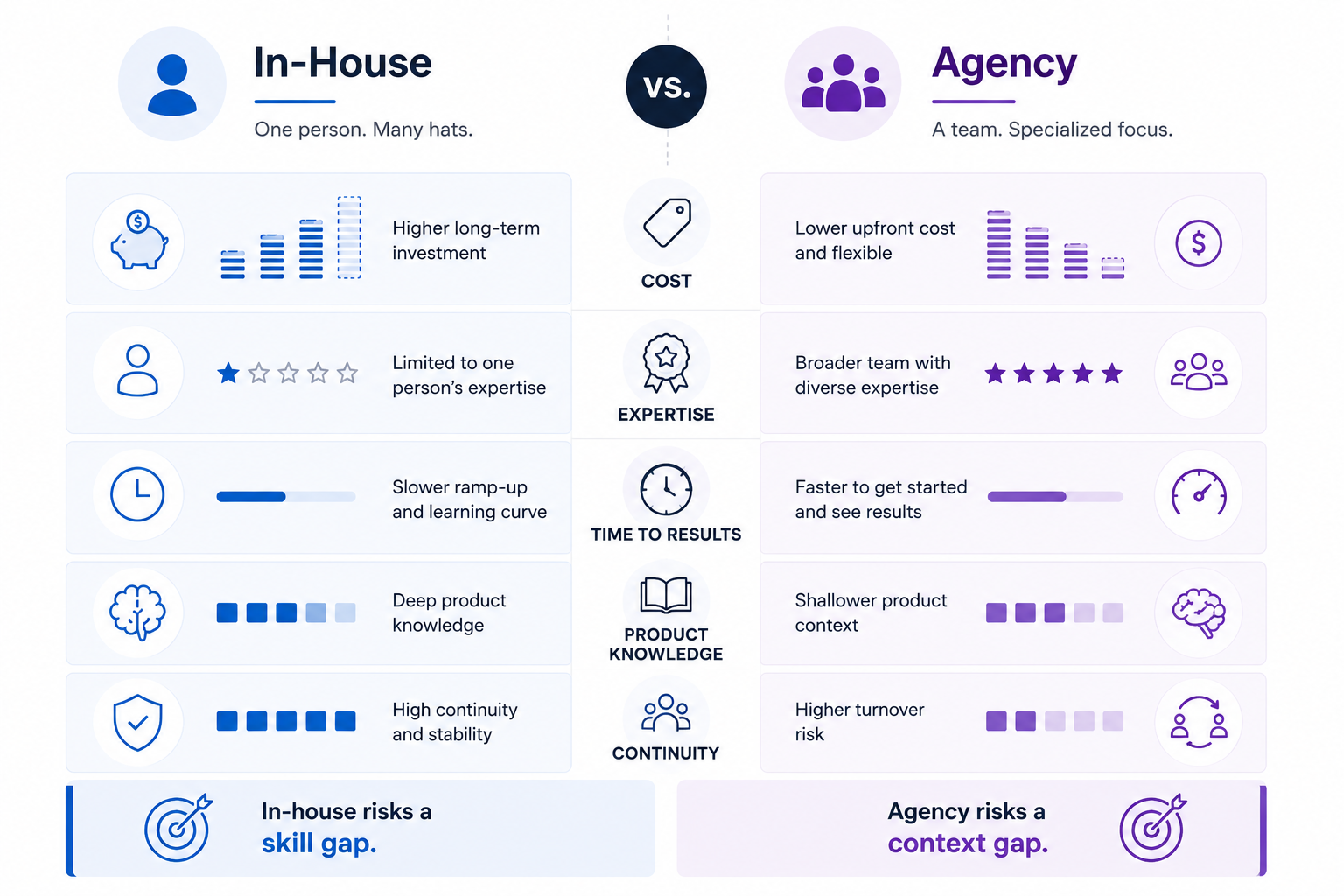
| Depth of expertise | One person's skill ceiling; usually strong in one of the three areas | Specialists across strategy, feed, and tracking |
| Total cost | Salary, taxes, benefits, tools, training | Fixed monthly retainer, tools included |
| Time to results | 2–4 months including onboarding and ramp-up | Audit and rebuild typically inside month one |
| Product knowledge | Excellent, immediate | Requires onboarding, improves over time |
| Availability | Dedicated to you full time | Shared across a client roster |
| Cross-account learning | Limited to your data | Patterns from dozens of similar stores |
| Tooling | Licensed per seat, often skipped on cost | Enterprise tools included in the retainer |
| Continuity risk | High; knowledge leaves when they do | Low; team-based coverage |
| Scalability | New markets need new hires | Capacity flexes with your spend |
| Accountability | Internal performance review | Contractual, reported monthly, replaceable |
So Which One Should You Choose?
For the large majority of ecommerce brands, an agency is the better decision.
The reason is structural, not promotional. Google Ads management for ecommerce requires three specialisms running in parallel, and a single hire will only ever be genuinely strong in one of them. You end up with excellent campaign settings on a broken feed, or a beautiful feed measured by tracking that double-counts purchases. An agency covers all three because it staffs all three.
The exception is narrow and worth stating plainly. If you are spending heavily enough to justify a dedicated team, if you already employ a proven ecommerce PPC specialist, and if your catalogue is stable enough that feed work is not a constant job, in-house can outperform. That describes a small share of stores.
The hybrid model is the practical middle ground and it works well. Keep strategy, margin data, and brand decisions in-house. Outsource execution: feed management, campaign builds, tracking, and reporting. Your marketer owns the direction, the agency owns the machinery.
What Good Ecommerce Google Ads Management Looks Like in Practice
Whichever model you choose, the standard is the same. Tracking is verified before any budget moves. Reporting shows profit after ad spend, not just ROAS. Feed work happens monthly, not at launch. And acquisition connects to retention, because margin comes from the second and third order, not the first.
This is how we run accounts at Evensen Marketing. We are an official ProfitMetrics partner, so campaigns are optimized on real profitability rather than revenue alone, and a certified Klaviyo and Mailchimp partner, so email flows are built alongside the ad strategy instead of being handed to a second vendor. Accounts stay in your ownership with agency access granted through MCC permissions.
If you want a read on where your current setup stands, our free audit covers campaign structure, tracking, and product feed. And whichever model you choose, our full ecommerce Google Ads strategy guide covers the execution playbook: campaign structure, tracking, bidding, and when to scale.
If you have already decided to outsource, our guide on how to choose a Google Ads agency for ecommerce covers the seven checks worth running before you sign. For typical fees and how agencies compare with freelancers, see our guide to ecommerce Google Ads agency costs and services.
Quick Answers: Frequently Asked Questions
These are the questions that come up most often from store owners weighing in-house versus agency management.
How can Google Ads benefit my ecommerce store?
Google Ads puts your products in front of people already searching for them, which makes it the highest-intent channel most stores have access to. Shopping and Performance Max campaigns show your product image, price, and reviews directly in search results, so shoppers arrive pre-qualified. The benefit is control: you can scale spend on profitable products, pause what loses money, and see the result within days rather than months. Unlike organic search, it works from day one, and unlike social, it captures demand that already exists.
How to run Google Ads for ecommerce?
Start with tracking, not campaigns. Verify GA4, Google Tag Manager, and Merchant Center are recording purchases once and accurately. Then optimize your product feed: clear titles with brand, product type, and key attributes, plus custom labels that group products by margin. Launch Shopping first to gather clean conversion data, add Performance Max once you have volume, and layer branded Search to protect your own terms. Set bid targets from margin rather than revenue, and review the feed monthly. Most accounts fail on tracking or feed quality, not on campaign settings.
Should I use Google Shopping ads for my ecommerce business?
Yes, for almost every store selling physical products. Shopping ads consistently deliver among the highest returns in ecommerce because the intent is explicit and the format shows the product before the click. Traffic is also typically cheaper than standard Search. The requirement is a working Merchant Center feed, which is where most of the work sits. If your catalogue has fewer than a handful of SKUs or your products need heavy explanation before purchase, Search and remarketing may serve you better.
How does the best Google Ads agency drive ecommerce sales?
By fixing measurement before scaling spend. The best agencies audit and rebuild conversion tracking first, then restructure the product feed so Google's automation has good signals to work with, then optimize toward profit rather than revenue. That sequence matters: scaling a campaign on broken data amplifies losses. Strong agencies also report on profit after ad spend and connect paid acquisition to email retention, so customer value is measured across the full lifecycle rather than the first order alone.
How much does ecommerce Google Ads management cost?
Agency retainers commonly run between $1,000 and $3,000 per month for small to mid-sized stores, often structured as a flat fee or a percentage of ad spend. In-house costs a full specialist salary plus benefits, tools, and training, which usually lands well above the agency figure once totalled. The more useful question is cost per outcome: what you pay divided by the profit the channel returns.
Can I switch from an agency back to in-house later?
Yes, provided your Google Ads account and Merchant Center are in your ownership from the start, with the agency working through MCC access. That way your historical performance data and accumulated machine learning stay with you. Confirm this in writing before signing, because accounts built inside an agency's own structure cannot be transferred with their history intact.
How long before Google Ads management for ecommerce shows results?
Expect first conversions and usable data within two to four weeks, and meaningful, consistent performance in 60 to 90 days. That timeline reflects how long automated bidding needs to gather conversion volume and stabilize. Accounts starting with a specialist tend to reach profitability faster because the structure is right from the beginning rather than rebuilt in month three.
Not Sure Which Model Fits Your Store?
At Evensen Marketing, we run ecommerce Google Ads accounts on profit, not just ROAS, with tracking, feed, and strategy handled by specialists from day one.
Get in touch via our contact form for a free audit of your current campaign structure, tracking, and product feed.