Hire a Google Ads agency for ecommerce that can prove it tracks profit, not just sales. The seven checks below take about an hour to run and they filter out most of the agencies that will waste your budget.
Choosing a Google Ads agency for ecommerce comes down to seven questions. Do they specialize in online stores? Do they know Shopping and Performance Max (PMax), the two campaign types that carry most store revenue? Do they fix your tracking before spending anything? Do they report on profit or only on sales? Have they run your category? Do they handle email and retention too? And can you leave without a fight?
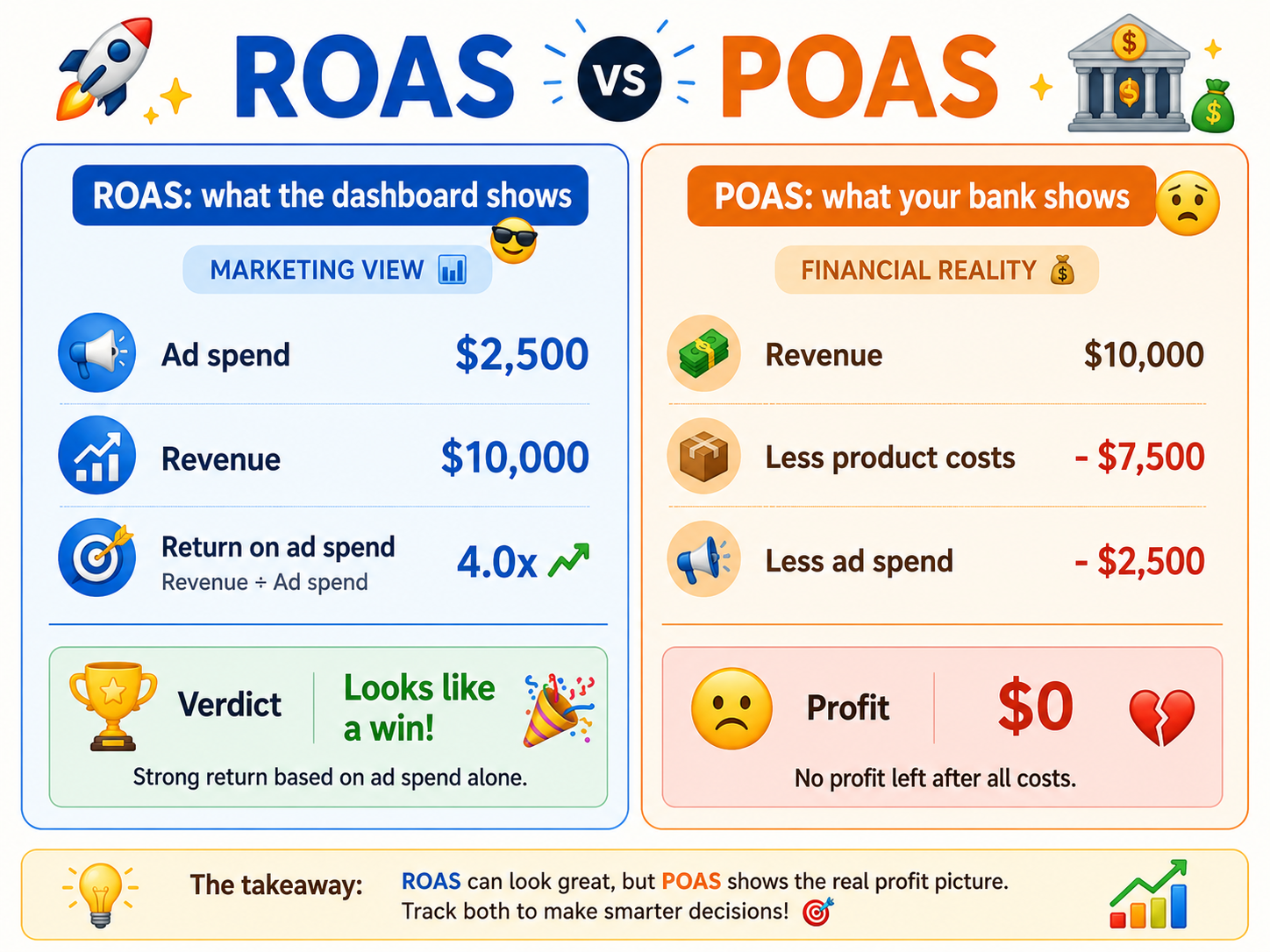
Two terms come up constantly, so here they are in plain language. Return on Ad Spend (ROAS) means revenue divided by what you paid Google. A 4x ROAS means every $1 spent brought back $4 in sales. Profit on Ad Spend (POAS) means the same calculation, but after your product costs and margins are subtracted. The difference decides whether you make money, because a 4x ROAS on a product with a 25% margin loses money on every order. Performance Max, often shortened to PMax, is Google's automated campaign type that pulls products from your feed and shows them across Search, Shopping, YouTube, and Display at once.
Choosing badly costs you in two ways. The first is paying for someone's learning curve while clicks keep getting more expensive. The average Google Ads cost per click (CPC) reached $5.42 in 2026, more than double the $2.32 recorded in 2016, according to WordStream's Google Ads benchmark study of over 13,000 campaigns. The second is scaling campaigns that look profitable on a dashboard and lose money on every order. Most stores never catch this because they are not measuring it. A Shopify merchant survey found that 77% of merchants track sales and total revenue, while fewer than half track profit margin, average order value (AOV), or conversion rate.
Most brands hire on the pitch deck. Six months later they find out the person who sold them the strategy has never opened their account.
What Makes the Best Google Ads Agency for Ecommerce Different
Lead gen and ecommerce are different sports. A lead gen shop optimizes for form fills, so a $40 cost per lead looks great on their reporting dashboard. Your store does not care about form fills. You care about what is left after cost of goods sold (COGS), shipping, discounts, and returns.
This is exactly where the ROAS and POAS gap bites. An agency optimizing toward a revenue target will scale whatever converts, including your thinnest-margin products. The dashboard looks like a win right up until you check the bank account.
The best Google Ads agency for ecommerce asks for your margin data on the first call. If nobody asks what your products actually cost you, they are guessing with your budget.
7 Requirements to Check Before Hiring an Ecommerce Google Ads Agency
1. Ecommerce Specialization, Not a Generalist Shop
Ask what share of their clients are stores. An agency running dentists, law firms, and two Shopify brands is learning your business on your budget. Ask for two accounts they have scaled that look like yours: same revenue band, similar AOV, similar catalog size. At Evensen Marketing we have optimized more than 500 Google Ads campaigns for ecommerce, and our case studies name real brands.
2. Real Depth in Shopping, Performance Max, and Search
Search is the easy part. Most store revenue sits in Shopping and Performance Max, and both live or die on your product feed. Ask how they handle title optimization, custom labels, and product exclusions. If the answer is "we just sync the Shopify feed and let Google figure it out," keep looking. The right campaign mix depends on your catalog and your goals, so it should be built for you, not pulled off a template.
3. A Complete Tracking Setup Before the First Dollar of Spend
Broken tracking is the most common problem in ecommerce accounts, usually duplicate purchase events or missing enhanced conversions. Before touching campaign settings, an agency should set up and verify Google Analytics 4 (GA4), Google Tag Manager (GTM), and Google Merchant Center together. This matters more than most owners expect. When we rebuilt conversion tracking for Gjertsen Sport, tracking rate improved 36% and revenue rose 42.4% year over year.
4. Profit Reporting, Not Just ROAS
Ask what shows up in the monthly report. You want profit after ad spend, new customer acquisition cost, and POAS alongside ROAS. Evensen Marketing is an official ProfitMetrics partner agency, so campaigns are tracked and optimized on real profitability rather than revenue alone. If the report you are shown is a screenshot of the Google Ads dashboard, you are paying someone to forward you data you already have.
5. Proven Experience in Your Vertical
Auction dynamics, margins, seasonality, and policy risk all change by category. An ecommerce Google Ads management agency that has run beauty knows which claims trigger a disapproval. One that has run sports retail knows what happens to CPCs in November. Ask whether they have worked your category, and ask what surprised them.
6. Retention Handled Alongside Acquisition
Paid search brings the first order. Margin comes from the second and third. If your agency optimizes acquisition while your email program sits idle, you are paying full price for every customer twice. Evensen Marketing is a certified Klaviyo and Mailchimp partner, so abandoned cart flows and retention campaigns are built where your ad strategy lives. Ask how acquisition and retention connect in their reporting.
7. Transparency, Account Ownership, and Terms You Can Exit
Your Google Ads account, Merchant Center, and GA4 property should sit under your billing and your ownership, with agency access granted through Manager Account (MCC) permissions. If they run you inside their own account, you lose your historical performance data when you leave. Then check reporting cadence and contract length. Real-time dashboards, a monthly report, and a 30-day notice period are reasonable. Twelve-month lock-ins with a 90-day cancellation window protect the agency, not you.
Google Ads Management for Ecommerce: Green Flags and Red Flags
| What to check | Green flag | Red flag |
|---|---|---|
| Client base | Mostly ecommerce, named brands, your revenue band | Mixed bag of local service businesses |
| Feed strategy | Title testing, custom labels, margin-based product tiers | "We just sync the Shopify feed" |
| Tracking | GA4, GTM, and Merchant Center verified before launch | Starts spending week one, no audit |
| Reporting | POAS and profit after ad spend, via a tool like ProfitMetrics | Impressions, clicks, and CTR only |
| Vertical experience | Dedicated case studies in your category | "Google Ads is the same everywhere" |
| Retention | Email flows and paid search under one strategy | Acquisition only, no lifecycle view |
| Account ownership | Your account, MCC access for them | Their account, your data held hostage |
| Terms | 30-day out, real-time dashboard access | 12-month lock-in, monthly PDF only |
Why Your Vertical Changes the Answer
Two categories account for most of the questions we get, and they behave nothing alike.
Google Ads for Beauty Products
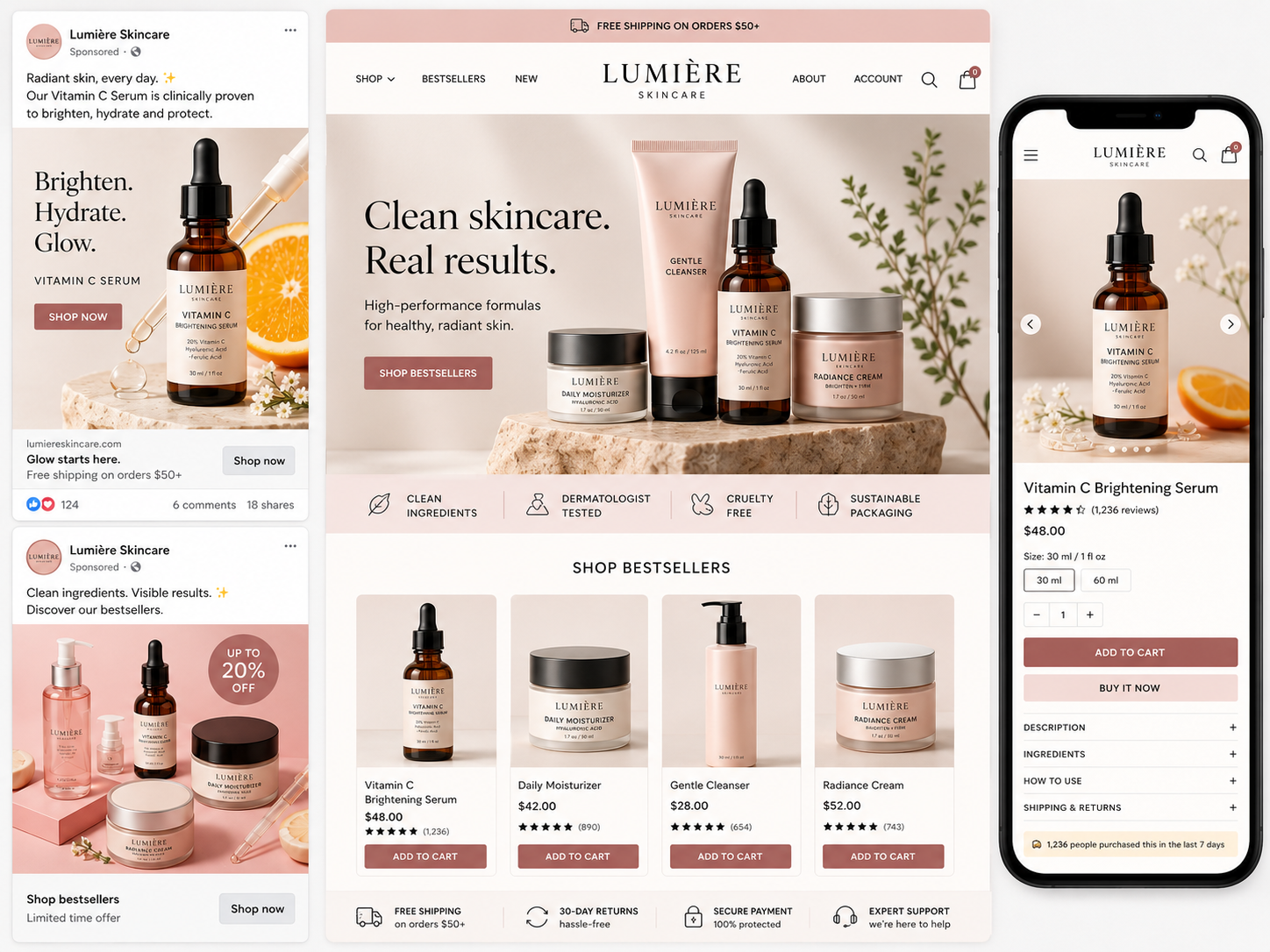
Beauty is crowded, brand terms get poached constantly, and shade variants make feed structure messy. Agencies running Google Ads for beauty products well separate branded from non-branded spend, and they keep competitor conquesting on a controlled budget instead of letting Performance Max quietly absorb it. Margin discipline matters here because discounting is the default competitive move.
Skincare Advertisements
This is where accounts get suspended. Skincare advertisements trip Google's healthcare and medicines policy when copy claims to treat acne, eczema, or rosacea. A good agency knows the difference between "hydrating" and "clears breakouts," and reviews landing page copy too, since Google scans the destination page and not only the ad. For Dermalogica Denmark, ROAS increased 176.35% in Q1 2026 compared with Q1 2025, alongside a 33.55% rise in conversion value.
Google Ads for Fitness Products
Equipment carries high AOV and long consideration windows, supplements carry policy risk. Running Google Ads for fitness products means watching attribution windows, because nobody comparing a $1,200 rower buys on the first click. Ask how the agency handles assisted conversions and view-through data before judging a campaign as underperforming.
Google Ads for Sports Products
Seasonality is brutal. Google Ads for sports products swings with league calendars, weather, and gifting periods, so budget pacing matters as much as bidding. Ask how they plan Q4 and how they handle a campaign when a popular size sells out mid-flight.
Your Ecommerce Google Ads Agency Vetting Checklist
Score each Google Ads agency for ecommerce out of 7. Under 5, keep interviewing.
- Ecommerce specialization — The majority of their clients are online stores, not a mix of service businesses.
- Shopping, PMax, and feed expertise — They can explain title optimization, custom labels, and product exclusion strategy.
- Full tracking setup before spend — GA4, GTM, and Merchant Center are verified and audited before any budget moves.
- Profit and POAS reporting — Monthly reports include POAS and profit after ad spend, not only revenue and ROAS.
- Experience in your vertical — They have named case studies or prior accounts in your product category.
- Retention built into the strategy — Email flows and lifecycle campaigns are part of the engagement, not left to another vendor.
- You own the account, 30-day terms — Your Google Ads account and Merchant Center are in your name, with a clear exit clause.
Still weighing whether to hire at all? Our guide on Google Ads management for ecommerce, in-house or agency breaks down the trade-offs in more detail, and our overview of what an ecommerce Google Ads agency costs covers pricing and freelancer options. And once your campaigns are live, our complete ecommerce Google Ads strategy guide covers what strong execution should look like month to month.
Quick Answers: Common Questions About Hiring an Ecommerce Google Ads Agency
How long before I see results from Google Ads for ecommerce?
Expect early data and first conversions within 2 to 4 weeks. Meaningful, consistent results from Google Ads management for ecommerce usually take 60 to 90 days, because that is how long it takes to test, gather conversion volume, and refine. Stores that start with a specialist agency tend to reach profitability faster, since the account is built on a proven structure from day one instead of being rebuilt in month three.
What is a ProfitMetrics partner agency, and why does it matter?
ProfitMetrics is a profit tracking platform that feeds real margin data back into Google Ads, so campaigns can be optimized on POAS rather than revenue. A certified partner agency is trained on the platform and has it integrated as standard. It matters because ROAS targets set without margin data will scale your least profitable products the fastest.
Do I keep my Google Ads account if I leave the agency?
Only if it was set up under your ownership from the start. If campaigns were built inside the agency's own account, you lose the historical data and the machine learning that took months to accumulate. Confirm ownership in writing before you sign.
Should the same agency handle Google Ads and email marketing?
Not always, but there is a real advantage when they do. Paid search and email share the same customer data, and abandoned cart flows and post-purchase sequences directly change what you can afford to pay for a first order. Split them across two vendors and someone has to own the handoff. Usually nobody does. Evensen Marketing manages both Google Ads and email marketing campaigns, so acquisition and retention are built and measured together.
Does my ecommerce Google Ads agency need to be based in my country?
No. Google Ads accounts are managed remotely wherever the agency sits, so the real question is whether they have run campaigns in your target markets. Ask about currency setup, local feed requirements, language variants, and shipping and returns expectations that differ by country. Evensen Marketing is based in Norway and runs campaigns across six markets worldwide. Overlapping working hours matter far more than a shared postcode.
Can an agency guarantee a specific ROAS?
No, and treat guarantees as a warning sign. Too much sits outside their control: your pricing, your site speed, your competitors' budgets, your stock levels. What a good agency commits to is a defined process, a testing roadmap, and honest reporting against agreed targets.
What should I ask on the first call?
Three questions surface most problems fast. Who will actually work on my account day to day? What did you find wrong when you looked at my account before this call? And what would make you turn down this project? The last one is the most revealing, because agencies that take everyone deliver for no one.
Ready to Check Your Own Account?
Evensen Marketing is a Google Ads agency for ecommerce brands, and the free audit covers your campaign setup, tracking, and product feed. No sales pressure, just an honest read on where the money is leaking. You will hear back within one business day.
Get in touch via our contact form to request your free audit.