
An ecommerce Google Ads agency helps online stores acquire customers through Google Search, Shopping and Performance Max while managing the technical and strategic work behind those campaigns. A good partner should understand more than clicks and ad spend. It should understand your products, margins, conversion tracking, Merchant Center feed, customer acquisition costs and the difference between revenue and profit.
The right agency is therefore not necessarily the one promising the highest ROAS. It is the one that can explain how it will improve your account, measure meaningful outcomes, protect your data and connect advertising performance with the economics of your business. A good ecommerce Google Ads agency should make that process transparent.
- A specialist can manage Search, Shopping, Performance Max, Merchant Center, product feeds, tracking and reporting.
- Published 2026 industry estimates put management fees anywhere from hundreds of dollars per month for freelancers to $4,000 or more for specialist agencies, depending on scope and spend.
- There is no universal good ROAS. Your target depends on product margins, operating costs, average order value and customer lifetime value.
- Before hiring an agency, check account ownership, ecommerce experience, tracking knowledge, Merchant Center expertise, reporting and who will actually manage your account.
- For larger catalogs, product level profitability and feed quality can be as important as campaign settings.
What Does an Ecommerce Google Ads Agency Do?
An ecommerce Google Ads agency manages paid acquisition for online stores using Google's advertising ecosystem. Depending on the business, this can include Search campaigns, Google Shopping, Performance Max, Merchant Center, product feed optimization, conversion tracking, landing page recommendations, reporting and ongoing testing.
Ecommerce advertising is closely connected to the products being sold. A campaign can generate traffic while still producing poor results if the wrong products are promoted, margins are too low, tracking is inaccurate or the website does not convert.
A specialist should ask which products are profitable, which searches indicate purchase intent, whether product data is accurate and how much the business can afford to spend to acquire a customer. These are the questions our ecommerce Google Ads management service starts with.
What Services Should You Expect?
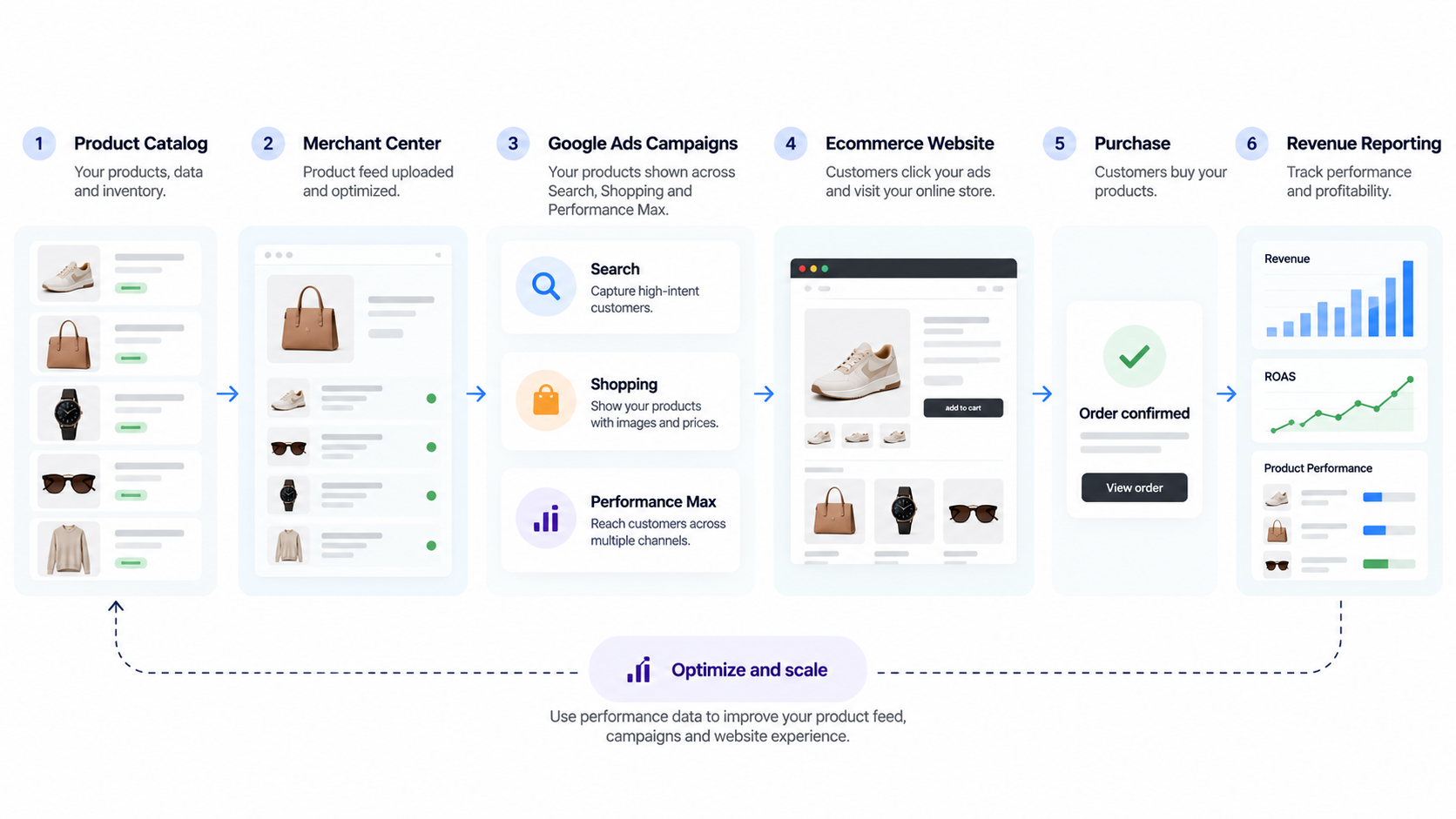
Google Search campaigns
Search campaigns can capture users actively looking for products, brands or solutions. An agency should distinguish between high commercial intent and broader informational searches and use that distinction to allocate budget appropriately.
Google Shopping
Shopping allows potential customers to see products, images, prices and store information in Google's results. Product data therefore matters. Titles, descriptions, categories, images, availability and pricing can all influence how products are represented.
An agency should be comfortable working with Merchant Center rather than treating the product feed as something that can simply be uploaded once and forgotten.
Performance Max
Performance Max is a goal based campaign type that can access Google's inventory across Search, YouTube, Display, Discover, Gmail and Maps. Google says the campaign uses automation and machine learning to optimize towards conversion goals and conversion value.
Automation does not remove the need for strategy. Conversion signals, product data, creative assets, product selection, budget and business objectives still influence the quality of the information available to the system.
Merchant Center and product feeds
Merchant Center problems can affect ecommerce advertising before a campaign even has a chance to perform. Disapproved products, missing attributes, incorrect prices or availability and weak product information can all create problems.
For larger stores, feed management can become a significant part of paid search work because different products may have very different margins, demand and conversion rates.
Conversion tracking
Accurate conversion tracking is fundamental. If Google receives incomplete or incorrect purchase data, automated bidding has less reliable information with which to optimize.
Your agency should be able to explain how purchases are tracked, what attribution model is being used and how Google Ads revenue compares with your ecommerce platform and analytics data. If you are unsure whether yours is accurate, conversion tracking is one of the first things we audit.
How Much Does an Ecommerce Google Ads Agency Cost?
Published 2026 industry estimates put management fees anywhere from $100 per month for freelancers to $4,000 or more for specialist agencies, depending on scope and spend.
Cost can depend on ad spend, product count, markets, campaign complexity, tracking, Merchant Center work, creative requirements and reporting.
For that reason, compare agencies based on what is included rather than comparing retainers alone.
Google Ads Agency vs Freelancer vs In House for Ecommerce
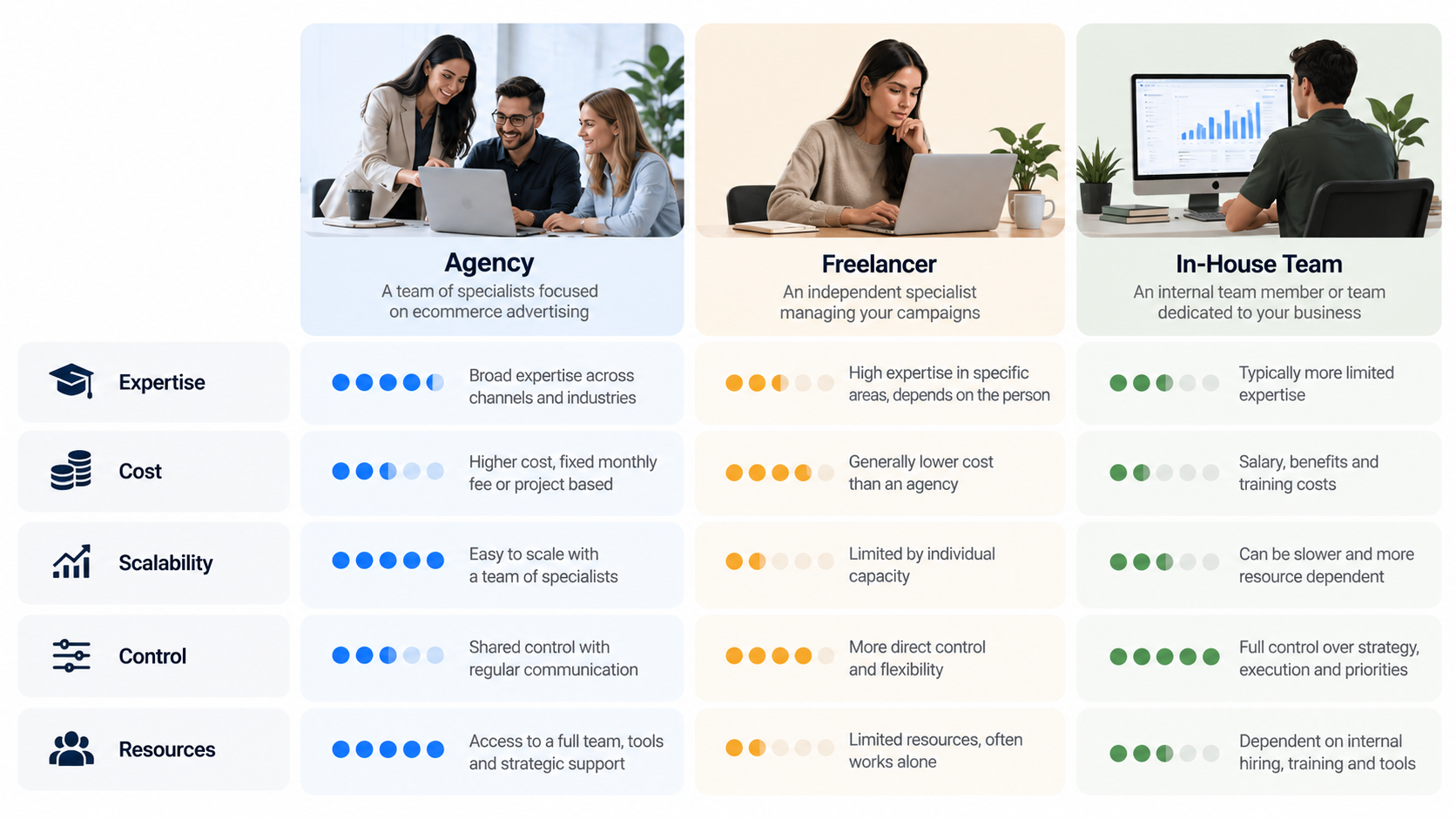
| Factor | Agency | Freelancer | In house |
|---|---|---|---|
| Expertise | Access to multiple specialists | Depends on individual | Depends on employee |
| Cost | Medium to high | Usually lower | Salary plus benefits and tools |
| Scalability | Usually strong | Depends on capacity | Depends on team size |
| Ecommerce experience | Should be verified | Should be verified | Can be developed internally |
| Multiple channels | Often available | Depends on expertise | Requires additional skills |
| Product feed expertise | Depends on agency | Depends on freelancer | Requires specialist knowledge |
| Control | Shared | Direct | Full internal control |
| Recruitment | No | No | Yes |
For a deeper look at the two most common options, see our comparison of in-house vs agency Google Ads management.
How to Choose an Ecommerce Google Ads Agency
1. Who owns the Google Ads account?
Your business should retain control of its advertising accounts. Ask whether your Google Ads account, Merchant Center account and relevant tracking infrastructure remain under your ownership. You should be able to change agencies without losing historical advertising data.
2. Who will actually manage the account?
The person selling the service may not be the person working on your campaigns. Ask who will manage your account day to day, how many accounts that person manages and how often your account will be reviewed.
3. Do they have ecommerce experience?
Ecommerce is not one category. Selling $20 beauty products is different from selling $2,000 furniture. Ask whether the agency has experience with your product category, average order value, target markets, ecommerce platform and monthly advertising budget.
This is why we run dedicated programs for beauty and skincare ecommerce brands and sports and fitness ecommerce brands, where margins, repeat purchase rates and seasonality work very differently.
4. How do they measure success?
ROAS is useful, but it should not be the only metric. Your agency should understand revenue, customer acquisition cost, product margins, average order value and, where appropriate, customer lifetime value.
5. How do they manage product feeds?
Ask whether the agency actively works on Merchant Center and product data or simply launches campaigns using an existing feed. For many ecommerce businesses, feed quality is an important part of the advertising system.
6. How often will they optimize campaigns?
Optimization should not mean making random changes every day. Ask what the agency monitors, what triggers a change and how tests are evaluated. Good optimization should be connected to data and business objectives.
Our guide on how to choose a Google Ads agency for ecommerce goes further, with seven checks and a green flag vs red flag table.
What Makes an Ecommerce Specialist Different From a General PPC Agency?
A general PPC agency may manage Search campaigns for many types of businesses. An ecommerce specialist also needs to understand the relationship between advertising and products. Ecommerce PPC requires a different approach because product feeds, conversion volume, campaign structure and product level profitability all influence how campaigns are managed. Search Engine Land PPC analysis highlights these differences, including the importance of feed optimization, campaign segmentation, accurate conversion tracking and profitability reporting.
- Product margins
- Inventory
- Product feeds
- Merchant Center
- Shopping campaigns
- Performance Max
- Product level profitability
- Ecommerce tracking
- Promotions
- Average order value
- Repeat purchases
- Customer lifetime value
For example, imagine an online store sells 500 products and 20 products generate most of its advertising revenue. That insight can change how budget is allocated. The business may want to prioritize products with strong margins, high conversion rates, sufficient inventory and strong customer demand.
What Is a Good ROAS for Ecommerce?
There is no universal good ROAS. A 3x ROAS might be profitable for one business and unprofitable for another.
Imagine a product sells for $100. If the business keeps $70 after product and fulfillment costs, it has considerably more room for advertising than a business that keeps only $30. Your break even ROAS should therefore be calculated from your own economics rather than copied from an industry benchmark.
Two current benchmark figures provide useful context, although they should not be treated as universal ecommerce targets. A Search Engine Land report on WordStream by LocaliQ's benchmark of 16,446 Google Ads campaigns found an average cost per click of $5.26 in 2025, up 12.88% year over year. The same study reported an average conversion rate of 7.52%, up 6.84% year over year. These figures cover multiple industries, so an ecommerce business should use them as context rather than as a target for its own account.
The better question is: what ROAS do we need to generate profitable growth for this particular business?
Red Flags When Hiring a Google Ads Agency
- Guaranteed ROAS before the agency understands your business
- Little or no discussion of conversion tracking
- No relevant ecommerce case studies
- Reporting focused mainly on clicks
- No explanation of Merchant Center or product feed management
- Unclear pricing or unclear responsibilities
- The agency refuses to explain who manages the account
- The agency controls the advertising assets without clear ownership arrangements
A credible agency should be able to show real results from stores like yours. You can see ours in our ecommerce Google Ads case studies.
When Should You Hire an Ecommerce Google Ads Agency?
External support can become useful when Google Ads is already important to your growth but managing it internally requires more time or expertise than you have available.
- You are already spending meaningfully on Google Ads.
- You have sufficient margin to invest in customer acquisition.
- Your account has become difficult to manage.
- You have a large product catalog.
- You are expanding internationally.
- You need Merchant Center expertise.
- You want help with Performance Max.
- Your conversion tracking is unreliable.
- You want regular performance analysis.
- You want to scale without immediately building a full internal PPC team.
What Should a Google Ads Agency Report?
A useful monthly report should tell you more than how many clicks your campaigns generated.
- Advertising spend
- Revenue attributed to advertising
- ROAS
- Purchases
- Cost per acquisition
- Conversion rate
- Average order value
- Campaign performance
- Product performance
- Search trends
- Budget changes
- Tests performed
- What changed from the previous period
- What will be tested next
How Evensen Marketing Approaches Ecommerce Google Ads
Evensen Marketing is an ecommerce Google Ads agency that works with online stores on paid acquisition and growth. Our approach combines Google Ads with the broader parts of the ecommerce marketing funnel that can influence advertising performance.
Rather than looking at Google Ads in isolation, we consider factors such as product margins, conversion tracking, product feeds and the value of the customers being acquired.
Google Ads and Shopping
We work across Google Search, Google Shopping and Performance Max campaigns. The focus is on understanding which products and search terms are generating meaningful results and how advertising spend can be allocated more effectively. Our ecommerce Google Ads strategy guide covers how we structure campaigns, tracking and bidding.
Tracking and profitability
We also work with profit based measurement, including POAS, or Profit on Ad Spend. ROAS measures attributed revenue relative to advertising spend, while POAS can provide an additional view by considering profit and product economics. As an official ProfitMetrics partner, we can optimize campaigns on product level profit rather than revenue alone.
Beyond customer acquisition
Paid advertising is only one part of ecommerce growth. We also work with ecommerce email marketing and customer retention as a Klaviyo and Mailchimp agency partner. This makes it possible to look beyond the initial advertising click and consider abandoned carts, repeat purchases and customer lifetime value.
When this approach can be useful
This type of approach is particularly relevant for ecommerce businesses that already have a functioning store and want to understand how advertising contributes to overall business performance. The focus is not simply on increasing ad spend, but on understanding which products, campaigns and customers contribute to sustainable growth.
If you want a second opinion on your current account, you can request a free Google Ads audit covering campaign structure, tracking and product feed.
10 Questions to Ask Before Hiring an Ecommerce Google Ads Agency
- Who owns the Google Ads account?
- Who manages the account every day?
- How much ecommerce experience do you have?
- Have you worked with businesses in my category?
- How do you calculate success?
- How do you approach Merchant Center?
- How do you handle conversion tracking?
- What does your monthly fee include?
- What happens if I decide to leave?
- Can you show me an anonymized example of your reporting?
FAQ
What is an ecommerce Google Ads agency?
An ecommerce Google Ads agency specializes in managing Google advertising campaigns for online stores. Services can include Search, Shopping, Performance Max, Merchant Center, product feeds, conversion tracking, reporting and campaign optimization.
How much does an ecommerce Google Ads agency cost?
Pricing varies according to advertising spend, account complexity, number of products, markets and services included. Published 2026 estimates range from hundreds of dollars per month for freelancers to $4,000 or more for specialist agencies.
Is Google Ads good for ecommerce?
Google Ads can be an effective customer acquisition channel because it can reach people searching for products and shopping related information. Results depend on demand, competition, pricing, margins, website conversion rate, tracking and campaign management.
Is an ecommerce Google Ads agency worth it?
It depends on the economics and complexity of the business. An agency can provide specialist expertise without requiring an internal team, but its cost should be evaluated against the additional revenue and profit it can realistically generate.
What is a good ROAS for ecommerce?
There is no universal target. Your acceptable ROAS depends on product margins, operating costs, average order value, customer lifetime value and your acquisition strategy.
Should I hire an agency or manage Google Ads myself?
Smaller stores with simple accounts may be able to manage campaigns internally. As advertising spend, product count, markets and campaign complexity increase, specialist support can become more valuable.
What should I look for in an ecommerce PPC agency?
Look for ecommerce experience, transparent reporting, strong tracking knowledge, Merchant Center expertise, clear account ownership, a defined optimization process and pricing that makes sense for your business.
Conclusion
Choosing a Google Ads partner is ultimately about finding a partner that understands both advertising and ecommerce economics.
The agency should be able to explain how it will manage campaigns, products, feeds, tracking and reporting. It should also understand that a high ROAS does not automatically mean a profitable business.
Before signing a contract, ask who owns your accounts, who manages them, how success will be measured, what is included in the fee and how advertising performance will be connected with actual store revenue.
Most importantly, do not choose an agency simply because it promises the highest ROAS. Look for an approach, level of expertise and reporting process that match the complexity and economics of your ecommerce business.
Looking for an Ecommerce Google Ads Agency?
At Evensen Marketing, we manage ecommerce Google Ads on profit, not just ROAS, with Merchant Center, tracking and reporting handled by specialists. Your accounts always stay in your ownership.
Get in touch via our contact form for a free audit of your campaign structure, tracking and product feed.